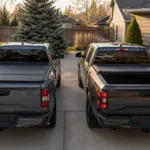

We’ve all seen it: a half-ton pickup cruising down the highway, rear bumper almost scraping the asphalt, headlights hunting for squirrels in the trees.
That’s not just a bad look—that’s a safety hazard waiting to happen.
Whether you’re hauling a bed full of gravel for a job site or loading up a slide-in camper for the weekend, understanding your truck payload capacity is the difference between a smooth ride and a blown transmission.
Here is the thing most dealerships won’t tell you: that massive “Max Towing” number in the brochure? It’s meaningless if you max out your payload first. Most folks think if the engine can pull it, the truck can handle it. But as any seasoned mechanic will tell you, it’s usually the suspension, tires, and cooling system that tap out long before the engine does.
In this guide, we’re cutting through the marketing fluff. We’ll break down what your truck can legally carry (checking that door jamb sticker), why the GVWR is your bible, and the real-world modifications—from air bags to upgraded cooling—that keep your rig level and safe when fully loaded.
Let’s get under the hood.
1. The “Legal” vs. “Real-World” Payload Dilemma
Before we talk about bolt-on upgrades, we need to have a serious talk about math. I know, nobody buys a truck to do algebra, but this calculation is the only thing standing between you and a citation—or worse, a denied insurance claim.
The Bible of Trucking: The Door Jamb Sticker
Forget what you read in the glossy brochure or heard from the salesman. Every single truck has a specific Yellow/White sticker inside the driver’s side door jamb.
This lists your specific vehicle’s Gross Vehicle Weight Rating (GVWR).

Here is the formula you need to tattoo on your brain:
Payload Capacity = GVWR – Curb Weight
But here is the catch: “Curb Weight” in the manual is for a base model. If you have added a winch, steel bumpers, or subwoofers, your truck is heavier than you think.
The only way to know your real available payload is to fill up your gas tank and drive onto a certified scale. I recommend using the CAT Scale Locator to find the nearest weigh station. It costs about $12, and it gives you the honest truth about how much weight you have left for cargo.
The Hard Truth About Modifications
This is the most common question I get in the shop: “If I add heavy-duty leaf springs, can I legally carry more weight?”
The answer is a hard NO.
Your GVWR is a legal rating determined by the factory based on the frame strength, axle ratings, and braking ability. No amount of aftermarket parts changes that legal number. If you get pulled over and scaled, the officer looks at the door sticker, not your fancy new air bags.
Furthermore, pushing your truck beyond these factory limits can land you in hot water with your manufacturer. Before you start throwing heavy mods at your rig, you should always check your warranty coverage to understand what is and isn’t protected if something snaps under a heavy load.
So, Why Modify at All?
If we can’t change the legal number, why are we here? Because there is a huge difference between legally carrying a load and safely carrying it.
Factory trucks are built for compromise. They are tuned to ride smooth when you’re driving to the grocery store empty. That means when you actually load them up to their legal limit, they squat, the steering gets light, and the handling goes to trash.
We modify payload capacity not to break the law, but to:
- Eliminate Squat: Keep the truck level so your headlights aim at the road, not the trees.
- Stabilize the Ride: Stop the “white-knuckle” floating feeling at highway speeds.
- Protect Components: Keep your suspension from bottoming out on every pothole.
2. Suspension Upgrades: Stop the Sag
Now that we’ve cleared up the legal side, let’s talk physics. When you drop 2,000 lbs into the bed, the rear end of a stock truck drops. We call this the “Squat.”
Squat is dangerous for three reasons:
- It unloads your front tires, killing your steering and braking traction.
- It blinds oncoming traffic because your headlights are pointing at the sky.
- It bottoms out your suspension, sending shockwaves through the frame.
To fix this, you have two main paths. As a mechanic, here is how I break it down for my customers:
The “Set It and Forget It” Route: Helper Springs
If you are a contractor hauling the same heavy toolboxes every single day, look at Helper Springs or upgraded Leaf Packs.
- How they work: These are stiffer springs that bolt onto your existing pack. They engage when the truck is loaded to provide extra support.
- The downside: When you aren’t hauling, your truck is going to ride like a covered wagon. Every bump will rattle your teeth because the suspension is too stiff for an empty bed.
The “Pro” Route: Air Suspension (Air Bags)
For most truck owners—especially if you tow a camper on weekends but commute empty on Mondays—Air Bags are the gold standard.
- The Benefit: Adjustability. You can run 5 PSI when empty for a factory-smooth ride, and pump them up to 50+ PSI when you load up the pallet of sod.
- The Result: You get a level truck regardless of the load. This keeps your geometry correct and your passengers happy.
3. Tires & Wheels: The Foundation
You can have the beefiest suspension in the world, but if you’re running passenger-rated tires, you are driving on a ticking time bomb.
I can’t tell you how many times I see a heavy-duty truck come in with “Squishy” tires. These are usually standard P-metric (Passenger) tires that came from the factory to improve MPG and ride comfort. They have soft sidewalls that flex and sway under heavy loads.
The “Load Range” Rule
If you are serious about payload capacity, you need to upgrade to LT-metric (Light Truck) tires, specifically those with a Load Range E (10-ply rating).
- Stiffer Sidewalls: Load Range E tires resist the “wallow” or swaying feeling when you hit a crosswind.
- Heat Resistance: Heavier loads generate massive heat in the tires. Thicker, heavier-duty tires dissipate this heat better, preventing blowouts.

According to the NHTSA (National Highway Traffic Safety Administration), tire failure is a leading cause of truck accidents, and under-inflation combined with overloading is the primary culprit.
Pro Tip: Don’t just upgrade the rubber; check your wheels. Factory aluminum wheels have weight ratings too. If you’re moving to aftermarket wheels, ensure their load rating matches or exceeds your truck’s GVWR requirements.
4. The Forgotten Heroes: Brakes & Cooling
Here is a phrase I tell every apprentice in my shop: “Going is optional; stopping is mandatory.”
When you max out your payload capacity, you are asking your braking system to convert a massive amount of kinetic energy into heat. If your brakes can’t shed that heat fast enough, you get Brake Fade—that terrifying moment when the pedal goes to the floor, but the truck keeps moving.
For heavy haulers, I always recommend upgrading to slotted rotors and heavy-duty tow pads. But there is a silent killer that takes out even more trucks than brake failure: Transmission Heat.
Managing the Heat Spike
When you are hauling 2,000 lbs up a grade, your transmission is working overtime. The fluid gets hot. If it gets too hot (over 220°F), it starts to cook the seals and clutches inside.
Most stock cooling systems are designed for empty commuting, not maximum exertion. Under heavy load, the stock airflow just isn’t enough. One of the best insurance policies you can buy for your powertrain is ensuring your cooling system is up to the task. This often means replacing tired stock components with upgraded radiator cooling fans that can pull more air through the radiator and transmission cooler when you are moving slow but working hard.
Don’t wait for the “Check Engine” light or a cloud of smoke. If you plan to haul heavy regularly, cooling isn’t a luxury—it’s a necessity.
5. Smart Bed Management & Aerodynamics
You’ve got the suspension, the tires, and the brakes. Now, how you load the bed determines if your truck handles like a sports car or a boat in a storm.
Center of Gravity (CG) Rules
Physics is unforgiving. When loading your bed, always follow these two rules:
- Low and Forward: Place the heaviest items (cement bags, engine blocks, tools) as far forward as possible, right against the cab. This keeps the weight on the front axle, maintaining steering traction.
- Lock It Down: A shifting load is a dangerous load. If 500 lbs slides backward when you accelerate, it instantly unloads your front wheels and can cause the truck to sway violently.
The Aerodynamic “Parachute” Effect
Many drivers don’t realize that an open pickup bed acts like a giant parachute at highway speeds. The air flows over the cab, crashes into the tailgate, and creates drag. This doesn’t just hurt fuel economy; it creates turbulence that can make a heavily loaded truck feel unstable.
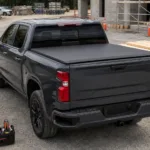
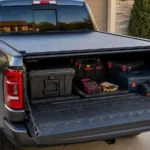
Installing a bed cover streamlines this airflow. Specifically, low profile quad fold tonneau covers are excellent for this because they sit flush with the bed rails, reducing drag significantly while keeping your expensive cargo secure from weather and thieves.

Unlike a bulky cap that adds even more weight high up (raising your center of gravity), a low-profile cover keeps things sleek. If you aren’t sure which style fits your specific workflow, check out our comprehensive guide on choosing a truck bed cover to see the pros and cons of folding vs. rolling systems.
6. Driving a Maxed-Out Rig: Pro Tips
You’ve done the math, upgraded the truck, and loaded the bed. Now you have to actually drive the thing.
Driving a truck at its maximum payload capacity is a completely different animal than driving empty. Physics is unforgiving, and a 7,000-lb truck carrying 2,000 lbs of cargo has the momentum of a freight train.
The 5-Second Rule
When you are empty, you might follow 2-3 seconds behind the car in front of you. When you are fully loaded, double it.Braking distance increases exponentially with weight. If traffic slams on the brakes, that extra ton in the bed wants to keep moving forward. Give yourself a 5-second buffer. You will thank me when the guy in the BMW cuts you off
Cornering: Slow In, Fast Out
This is racing advice that applies perfectly to hauling. Never brake in the middle of a turn when you are heavy. The weight shift can cause the rear end to swing out (oversteer).
- Do your braking in a straight line before the turn.
- Coast through the apex.
- Gently accelerate out.
Protect the Cabin
Often, hauling heavy loads means working in environments that aren’t exactly clean—construction sites, muddy fields, or gravel pits. While you’re focused on the suspension outside, don’t trash the inside.
I always tell my customers to invest in heavy-duty floor mats before a big job. It’s a lot easier to hose off a rubber mat than to scrub mud and grease out of your factory carpet after a long day of hauling.
7. FAQ (The Mechanic’s Corner)
I hear these questions in the shop every week. Let’s set the record straight.
Q: Can I legally increase my truck’s payload capacity?
Short Answer: No. The Mechanic’s Take: Your truck’s GVWR (Gross Vehicle Weight Rating) is a federally certified number. Installing air bags, heavier springs, or E-rated tires does not change the number on your door sticker. These upgrades are strictly for load leveling and handling safety, not for increasing the legal weight limit. If you need to legally carry more weight, you need a bigger truck.
Q: Do helper springs or air bags increase payload?
Short Answer: They increase capability, not capacity. The Mechanic’s Take: Think of it like a weightlifter wearing a back brace. The brace helps them lift the weight safely without hurting their back, but it doesn’t make their muscles stronger. Suspension upgrades keep your truck level and stable, preventing the rear suspension from bottoming out, but the axles and frame still have the same breaking point.
Q: What actually breaks if I exceed my payload capacity?
Short Answer: The weakest link. The Mechanic’s Take: usually, it’s not the engine. The first things to go are typically:
- Wheel Bearings: They get crushed under the load and start grinding.
- Rear Axle Shafts: They can snap or bend.
- Transmission: Overheating leads to premature failure.
- Brakes: They overheat and glaze over, leading to total brake fade.
Conclusion
At the end of the day, understanding truck payload capacity isn’t just about avoiding a ticket—it’s about respect. Respect for the machine, respect for the physics of the road, and respect for the safety of the families driving next to you.
Don’t let the marketing brochures fool you. Check your door sticker, know your real numbers, and ensure you have the right gear. Whether you need suspension helpers or just quality truck parts to keep your rig running reliable, always choose durability over shortcuts.
Keep the rubber side down, and I’ll see you on the road.